It's 1 a.m. You've just finished a "Which personality type are you?" quiz. The result calls you a rare, misunderstood soul. You feel seen. For about ten minutes.
Then the doubt creeps in. Is this actually me? Or did I just click what sounded nice?
A proper personality assessment works very differently. It's slower, deeper and done with a trained psychologist, not an app. So let's walk through how it really works.
What Is a Personality Assessment?
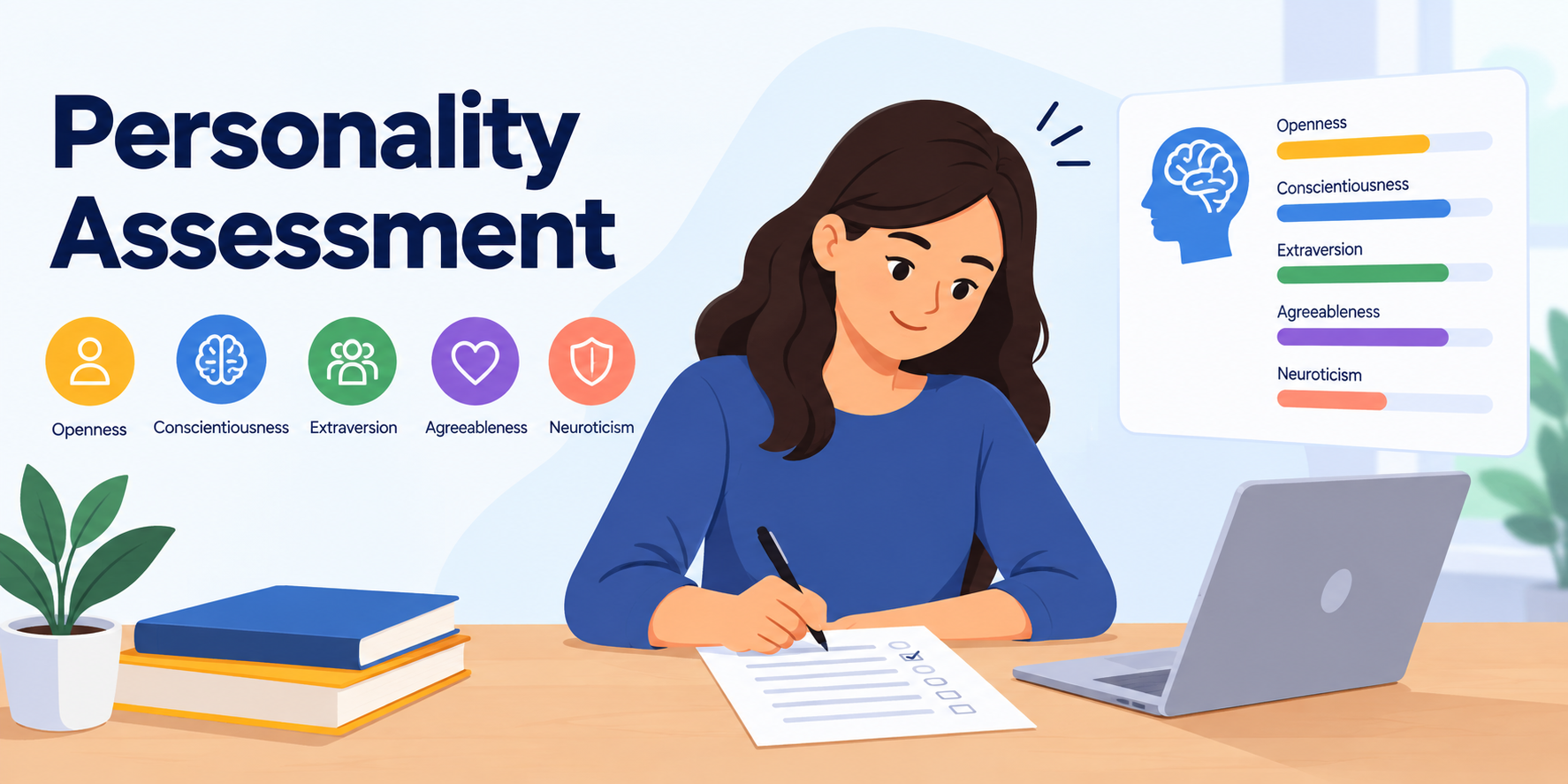
A personality assessment is a structured process in which a psychologist studies your patterns of thinking, feeling and behaving. It uses both self-report and projective measures, which can build self-awareness and give clinicians insight into your personality patterns. You receive a written profile and a feedback conversation.
It describes tendencies. It does not label you or predict your future.
Personality Assessment vs Online Personality Test
Remember: A quiz can be a fun past-timer activity. But, an assessment is meant to be used.
How a Personality Assessment Works: 5 Steps
Step 1: Intake conversation: The psychologist asks why you want an assessment, and about your background.
Step 2: Choosing the means: They pick tests that fit your question. Career clarity needs a different approach from therapy planning.
Step 3: Testing: You answer questionnaires and complete tasks. The MMPI-2, for instance, takes one to two hours.
Step 4: Scoring and interpretation: Clinicians take days to weeks to score and interpret results. They read them alongside your interview.
Step 5: Feedback and report: A feedback session follows, to review findings and recommendations.
Two Kinds of Tests You Might Meet
1.Self-report inventories: The MMPI is a self-report inventory with structured questions. The MCMI is another example, and both appear on Mind Veda's services list. 2.Projective tests: In the Rorschach, you interpret ambiguous inkblots. In the TAT, you tell stories about eight to twelve ambiguous pictures. Draw-a-Person and House-Tree-Person use drawings.
Before you go: Evidence supporting projective tests is mixed. So careful psychologists treat them as one input, never the verdict. That's why one test is never enough.
Who Should Conduct a Personality Assessment?
Tests like the MMPI-2 are meant to be administered and interpreted by a clinical psychologist or psychiatrist.
In India, a clinical psychologist should be enrolled on the Central Rehabilitation Register.
So, before you start opening up, ask for the CRR number. Also, make sure to check it on the official RCI portal.
Also, be very aware of ‘instant results’ with no interview. Keep in mind that mental health issues are best addressed with time and patience. Therefore, any such institutions guaranteeing ‘instant results’ might just be wasting your money!
When Does a Personality Assessment Help?
A personality assessment comes to great help during the following situations—
Career confusion- After Class 12 or graduation, when the “what have you decided?" has no easy answer.
Stuck therapy- Psychometric evaluation can guide diagnosis and customise treatment plans.
Repeating relationship patterns- Same fight, different person.
High-pressure phases- Exam preparation, job changes, burnout. Knowing how you handle stress is practical.
When It May Not Be the Right Step
Mental health issues can get highly stressful. So, you should seek help when you can’t handle it alone.
However, have you ever thought that when is the right time to take that step? Well, here are a few factors to help you out—
When you're in acute distress. Remember, support comes first. Everything else can be handled later on.
When you want a verdict to win a family argument.
When you feel pressured to take it.
When you want a diagnosis from a quiz.
Is the UPSC "Personality Test" a Personality Assessment?
Honestly, no! Despite its name, the UPSC Personality Test is an interview at the end of the day. Its stated aim is to assess a candidate's personal suitability for a career in public service. The technique is a directed, purposive conversation, not a strict cross-examination.
So, it does not qualify as a psychometric test.
A psychological personality assessment isn't designed to predict interview marks. But aspirants sometimes use one to understand their stress patterns and strengths while preparing.
What You Get at the End
Following are the things you get at the end of your personality assessment test—
A written profile of strengths and patterns
Insight into stress responses and triggers
Practical suggestions for therapy, career or relationships
A feedback session to ask questions
If the report is full of jargon, ask for plain language. You deserve to understand your own results.
How to Prepare for One?
Sleep well the night before.
Answer honestly. Remember that there is no "ideal" answer.
Ask which tools will be used and what you'll receive.
Bring your questions for the feedback session.
Personality Assessment at Mind Veda
At Mind Veda, personality assessments sit alongside counselling. So results turn into action, not a printout in a drawer. Your psychologist selects tools to suit your question.
Ready to take on your first personality assessment test? Call Mind Veda Today.
FAQs
1.What is a personality assessment?
It is a structured process where a psychologist uses an interview and standardised tests to understand your personality patterns. 2.How long does a personality assessment take?
It depends on the tools. One test like the MMPI-2 can take one to two hours. With the interview, scoring and feedback, the process often spans more than one sitting. 3.Is an online personality test the same as a personality assessment?
No. Online quizzes are quick and usually done for entertainment purposes. An assessment is interpreted by a trained psychologist. 4.Who can do a personality assessment in India?
A qualified psychologist is eligible to conduct personality assessment tests. 5.Can a personality assessment diagnose a mental illness?
Not on its own. It can help clarify a diagnosis alongside standardised screenings and a detailed clinical interview. 6.Is the UPSC Personality Test a personality assessment?
No. It's an interview by a board assessing suitability for public service.