What would you do if you’ve had a fever for three weeks? Will you listen to motivational speakers and stick with the ‘think positive and carry on’ attitude, or will you consult a doctor?
Easy. You’ll seek medical attention, right?
But what if you’re feeling low for three months straight, or can't switch off your thoughts at night? It can’t be because you’re going through ‘some stress,’ right? As humans, we're extremely good at ignoring the mental health issues we'd never ignore in our body.
In this blog, we’ll take a detailed look at what mental health problems actually are, and how to recognise them. Added to that, we’ll also help you understand when to reach out to a professional.
What Are Mental Health Issues?
In simple terms, mental health issues are conditions that affect three things—
Thoughts
Emotions
Behaviour
The number might surprise you, but there are more than 200 types of mental health problems, starting from anxiety and depression to schizophrenia and eating disorders.
Interestingly, every person has their own rough patches. But, it becomes an ‘issue’ when the symptoms begin to persist, and cause frequent distress, which disrupts your ability to function.
How Common Are They in India?
Well, mental health conditions are more common in India than most of us assume!
India's National Mental Health Survey found that about 10.6% of adults live with a mental disorder. The burden was higher in urban areas (about 13.5%) than in rural ones (6.9%).
However, the overall treatment gap was 84.5%, meaning roughly five in six people needing care weren't getting it.
So, to put it simply, many people are struggling, and most of them are doing it alone. That’s alarming enough for us to understand the importance of mental health conditions, and address them accordingly.
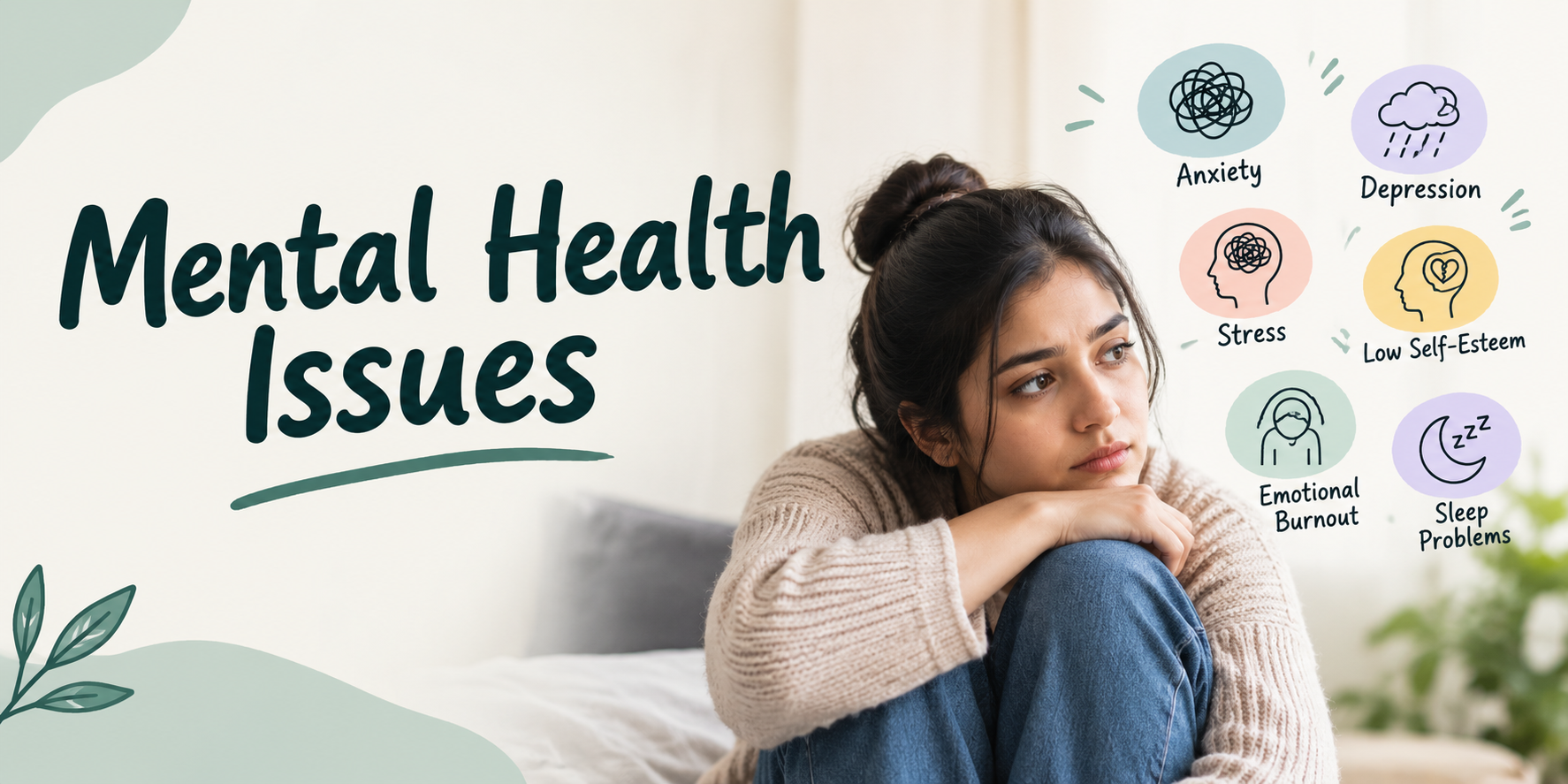
Common Mental Health Issues
Now that you’re aware of the mental health scenario of India, here are some of the most common issues that you may see in or around you—
Anxiety issues: constant worrying, experiencing panic attacks, social anxiety, etc.
Depression: feeling low persistently, loss of interest, exhaustion that sleep doesn't fix.
OCD: unwanted, repetitive thoughts and rituals to relieve them.
ADHD: feeling troubled while focusing, organisation and impulse control, in children and adults.
Trauma-related conditions: flashbacks, nightmares, feeling constantly on edge after a distressing event.
Substance use disorders: using alcohol or drugs in ways that harm health and relationships.
Stress and burnout: not a diagnosis on its own, but a common route into anxiety and depression.
What are the Warning Signs?
It’s not that a single symptom or sign means you have a troubled mental health. So, rather than looking at an individual symptom, look for patterns that last, or things that you tend to repeat for a couple of weeks or more.
Sleeping much more or much less than usual
Significant shift in appetite or weight
Retreating from friends and family
Irritation or anger that feels out of control
Having trouble to concentrate or make simple decisions
Unnecessary headaches, stomach trouble or fatigue
Pulling away from things you used to enjoy
Drinking or indulging in substance abuse as coping mechanism
Thoughts of self-harm, or that life isn't worth living
Pro Tip: If you’re facing the last symptom, understand that it needs attention right away.
Why Do So Many People Wait?
You might be thinking if the signs are this common, why does help take so long?
Well, it is usually it's a mix of—
Stigma: Fear of what relatives or neighbours will say.
Dismissal at home: Your feelings get cancelled out with a single sentence: “Everyone gets stressed. Learn to adjust or compromise”
Not knowing who to see: Psychologist, psychiatrist, counsellor— the names alone can feel like a maze.
Psychologist, Psychiatrist or Counsellor: Whom to Consult First?
A Psychologist assesses and treats through therapy such as CBT. Also, they don’t prescribe medicines.
A Psychiatrist is a person with a medical degree. They can diagnose and are certified to prescribe medication.
A Counsellor is someone who offers guidance and emotional support for specific life concerns.
That said, many people benefit from a psychologist and a psychiatrist working together. So, if you're unsure where to begin, a psychologist consultation is the most sensible baby step. They can assess what's going on and refer you to a psychiatrist if medication might help.
What Actually Helps
In many cases, mental health issues wear away with the right treatment, especially when the process starts early.
Therapy: Approaches like CBT and DBT can help. These procedures teach practical skills for thoughts, emotions and behaviour.
Medication: For some conditions, mild medications might be required. But, it should be prescribed and monitored by a psychiatrist.
Daily foundations: Steady sleep, movement, and a few people you can be honest with. They don't replace treatment, but they make it work better.
Family support: It's much easier to get better when people at home take it seriously.
How to Bring It Up at Home?
Confessing such issues in front of your family might feel daunting, especially because a majority of Indian households don’t even consider these as ‘real-world issues.’
So, try with this one honest sentence: "I've been struggling for a few weeks, and I'd like to talk to a professional."
Also, you don’t need to gather all your family members to address this issue. Start with one person, a sibling or a friend. This can make the next set of conversations easier.
Where to Get Help
At Mind Veda, our team, including RCI-registered psychologists, works with anxiety, depression, OCD, ADHD, stress and more. We also have an experienced consultant who can listen to your problems, and guide you to seek the right kind of therapy.
FAQs
1.What are the most common mental health issues?
Depression and anxiety are two of the most common mental health problems in India, alongside OCD, ADHD, trauma-related conditions and substance abuse disorders. 2. How do I know if it's stress or a mental health issue?
Stress usually eases when the pressure wears away. If low mood, worry or other symptoms last for weeks and interfere with daily life, consider getting evaluated. 3.Can mental health issues be cured?
Well, some improve completely, while others manage their issues for the long-term, much like other chronic conditions. Either way, treatment can bring real relief. 4.Do I need medication?
Not always. A couple of therapy sessions might feel enough for many people. The best way to determine this is to get evaluated by a psychiatrist. 5.Is online therapy effective?
For many people, yes. What matters most is a qualified professional and sticking with the sessions.